Belief and identity
How inherited and repeated scripts participate in the identities people inhabit.
literary psychology
How Belief Shapes Identity and Reality
Magic Logic is a work of literary psychology about belief, identity, attention and the patterns through which inner understanding becomes lived experience.
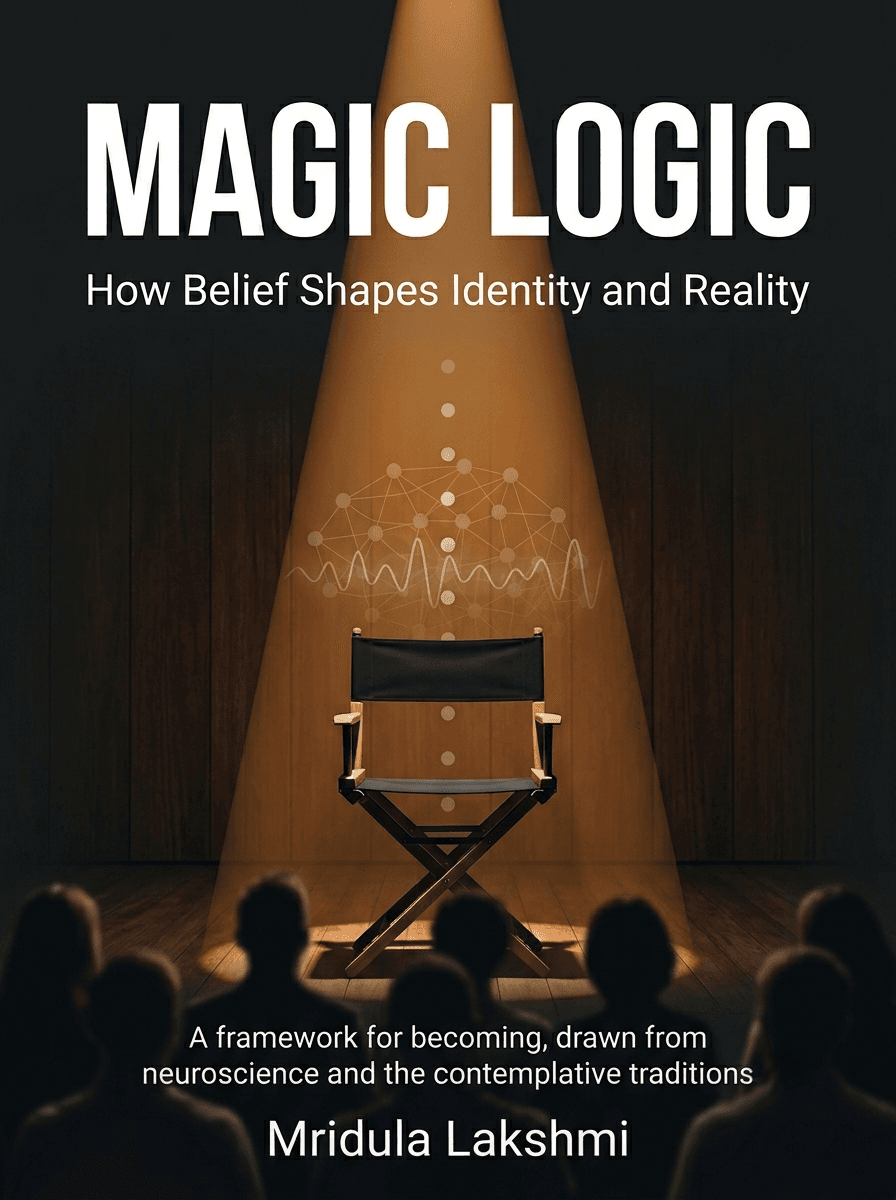
The proposition
Magic Logic is a work of literary psychology about belief, identity and the patterns that shape how we meet our lives.
Through the Theatre of the Self, the Master Equation, the Mirror Activity, the Spellbook and other reflective frameworks, the book moves from noticing inherited scripts to practising new ways of seeing and choosing.
For reflective adult readers interested in the distance between understanding a pattern and living differently in its presence.
How inherited and repeated scripts participate in the identities people inhabit.
How noticing creates distance from a pattern without turning observation into a verdict.
Why the version of a practice that can be repeated matters more than a heroic version.
How patterns travel through mind, body, world, maintenance and community.
A working model
The equation at a glance. The book develops each term—and their relationship—in context.
STATE × REPETITION × WITNESS = IDENTITY
The Master Equation is presented as the book’s working model.
Reflective structures
A literary model of Stage, Script, State, Tools, Audience and Director for seeing the production already underway.
A reflective practice for noticing what happens in thought and body when an identity statement is spoken.
Beginning with the least resistant version that can actually be repeated.
A daily record organised around State, Action and Evidence.
“The book is a laboratory. You are the variable.”
Magic Logic, Part One
A clear boundary
Magic Logic is reflective writing and literary psychology. It is not therapy, diagnosis, treatment, crisis support or medical advice.
Magic Logic is currently available as a Kindle edition. Information about print and audiobook editions will be announced later.
Questions
Format, audience, publication and scope.
It describes reflective, idea-led writing about interior patterns and identity. It does not mean clinical psychology, therapy or medical guidance.
It is written for reflective adult readers interested in belief, identity, patterns and the distance between insight and lived practice.
Magic Logic was published on 9 June 2026.
No. Amazon provides Kindle reading options for supported phones, tablets and computers as well as Kindle devices. Check Amazon’s current reading guidance for device compatibility.
Magic Logic is currently available as a Kindle edition. Information about print and audiobook editions will be announced later.
Yes. The book includes the Theatre of the Self, the Master Equation, the Mirror Activity, Minimum Viable Practice, the Spellbook and other reflective structures.